
We started this lecture by presenting our mind maps that we had created for our Power point presentations.
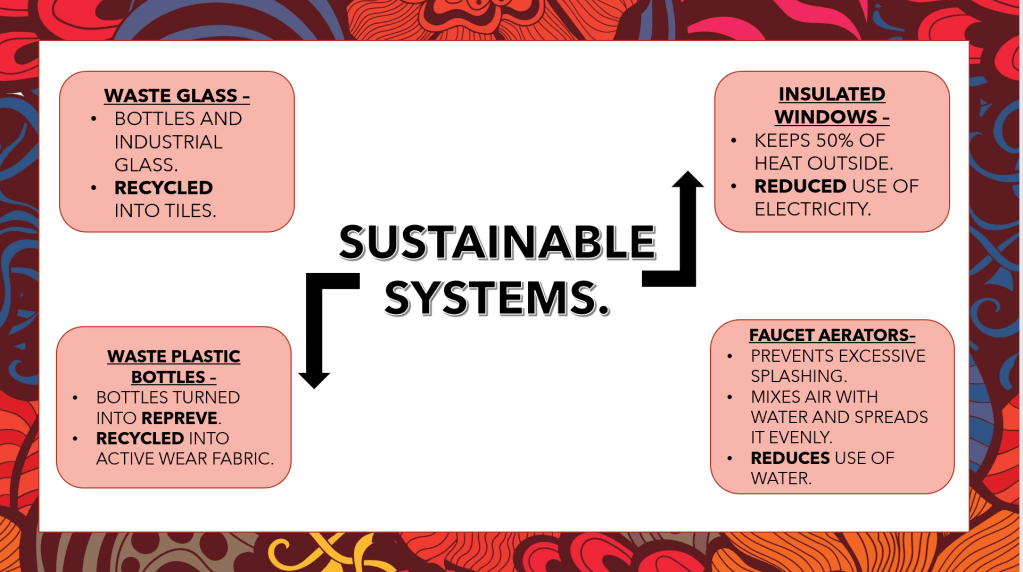
Above is the mid map i created. I sorted out the materials i had chosen and placed them under 3 categories – Reduce, Recycle and Reuse.
Next we studied inter-dependency of environmental and economic issues with one another. A balance between ecosystem, there is an outcome of equal participation and existence of all stakeholders and biological communities. Some great examples are the Great Barrier Reef in Australia and the Swacch Bharat Abhiyan in India.
An ecosystem is a community of living organisms in conjunction with the nonliving components of their environment, interacting as a system.These biotic and abiotic components are linked together through nutrient cycles and energy flows.Energy enters the system through photosynthesis and is incorporated into plant tissue. By feeding on plants and on one-another, animals play an important role in the movement of matter and energy through the system. They also influence the quantity of plant and microbial biomass present. By breaking down dead organic matter, decomposers release carbon back to the atmosphere and facilitate nutrient cycling by converting nutrients stored in dead biomass back to a form that can be readily used by plants and other microbes.
Biodiversity is the variety and variability of life on Earth. Biodiversity is typically a measure of variation at the genetic, species, and ecosystem level. Terrestrial biodiversity is usually greater near the equator, which is the result of the warm climate and high primary productivity.Biodiversity is not distributed evenly on Earth, and is richest in the tropics.
Stakeholders are people who are in charge of making decisions, who are affected by these decisions, people with an interest or concern in something, here referring to the environment.
This lecture ended by ma’am giving us a group assignment. My groups’s topic was Affordable and clean energy. We had to create a ppt on the same for next class.

 DISHA KALYANI